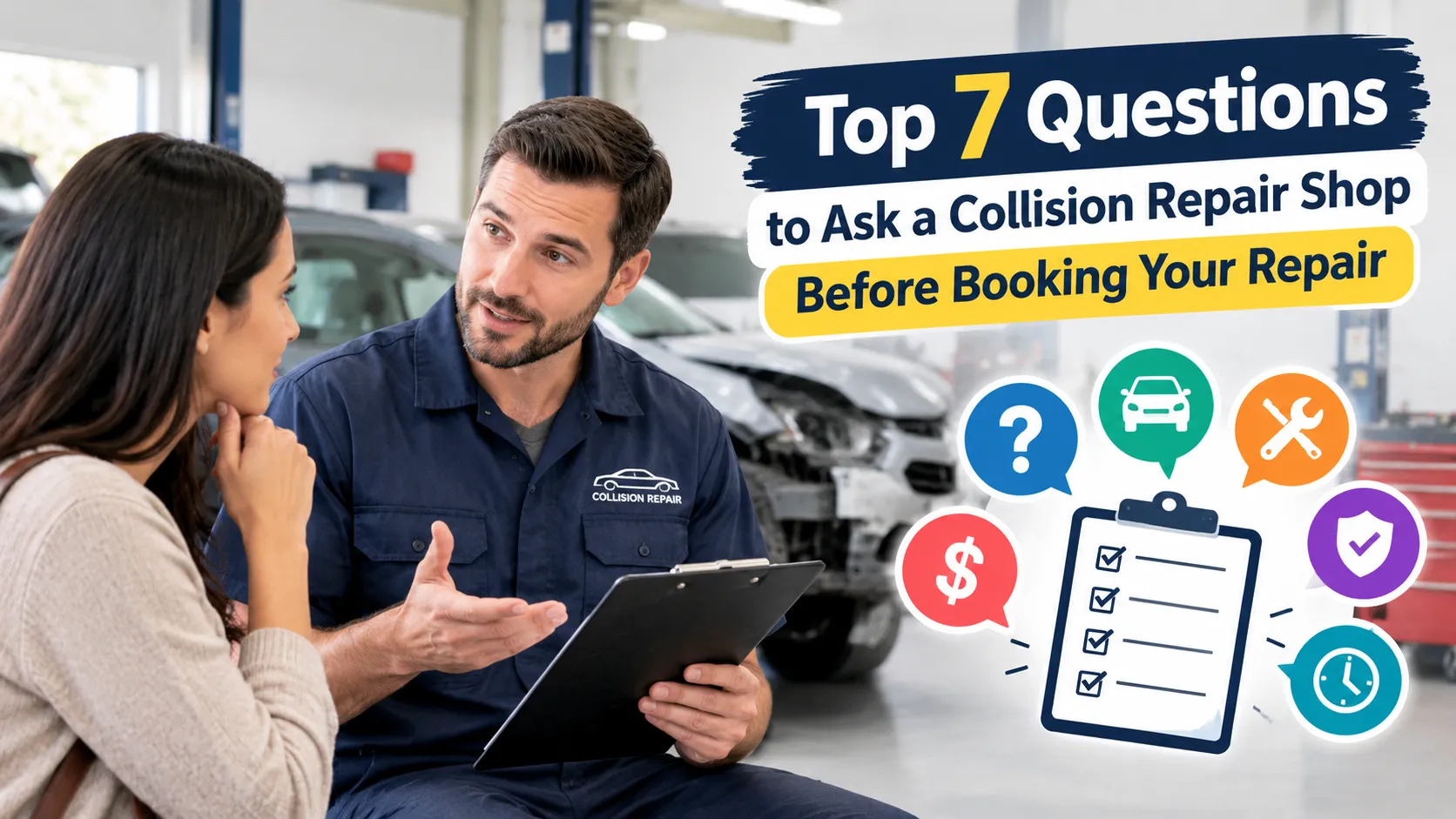
After a collision, most drivers walk around their car looking for one thing: does it look right? Paint matches, bumper sits flush, panels line up. Good enough, right? Not always. There is a whole layer of repair work that never shows up on the surface — work that will not appear on a basic estimate either, unless you know the right questions to ask a collision repair shop before you commit. Modern cars have safety features that require placement of sensors and proper calibration after repairs to work correctly. If you skip this step do it incorrectly or never check on it you end up driving a car that appears fixed but isn’t safe. Here is what to ask about what good responses should. Why this is more important than most drivers understand.
Why a Car That Looks Fixed Can Still Be Dangerous
There are two sides to every collision repair. The visible side — paint, panels, glass, dents — is what most people check. The other side is structural and electronic, and it is the side that actually determines whether the vehicle is safe to drive.
ADAS — advanced driver assistance systems — runs everything from automatic emergency braking to lane departure warnings and blind-spot detection. Every one of those features depends on sensors, cameras, and radar units sitting in precise positions. Move a sensor housing a few degrees during a repair without recalibrating it afterward, and the system’s targeting is off. No warning light. No fault code. Nothing to tell you something is wrong.
That is the problem with the assumption most people walk away with: airbag light off, car drives straight, repair is done. None of that confirms your ADAS is working. A forward-collision sensor can be pointed off-axis and still produce a clean dashboard.
Structural integrity works the same way. Unibody frames need post-repair measurement against OEM specifications — not a visual pass. Micro-deformation in high-strength steel is invisible to the eye. A shop calling a visual check a structural verification is guessing, not confirming.
The 7 Questions, and What the Answers Actually Tell You
1. Do you follow OEM repair procedures for this vehicle’s make and model?
Every manufacturer publishes repair procedures specific to each model — what materials to use, how to handle structural components, which systems need recalibration after certain repairs. Shops that skip these procedures usually do so because insurer estimates do not always budget for them. Ask which database or portal the shop references. Shops doing this right will name it — I-CAR’s Repairability Technical Support, OEM1Stop, or the automaker’s own repair portal. “We follow industry standards” is a non-answer.
2. Will you perform both a pre-repair scan and a post-repair scan?
A pre-repair scan logs existing fault codes before work begins. A post-repair scan checks whether the repair process introduced new ones. Plenty of shops run the first and skip the second. The post-repair scan is the only record confirming your vehicle’s electronic systems came out of the repair intact. Get both reports in writing before you sign off on the job.
3. Is ADAS recalibration handled in-house, or is it sublet to a third party?
This question is one of the important to ask a collision repair shop yet it is rarely asked. When calibration is sublet accountability fractures. A problem that appears after pickup turns into a back‑and‑forth between two businesses, about whose responsibility the problem’s. In-house calibration — using a dedicated target space and manufacturer-specified equipment — keeps the work and the warranty in one place.
4. How do you verify structural integrity after the repair?
Push past vague answers here. Frame measuring systems — Chief, Car-O-Liner, Spanesi — and computerized pulling benches track structural measurements against OEM specs in real time. Those are the tools a serious shop uses. If the answer is a road test or a visual walkthrough, the shop is not verifying structural integrity. They are assuming it.
5. Are your technicians I-CAR Gold Class certified, or manufacturer-certified for my vehicle?
“We’re certified” tells you nothing useful. I-CAR Gold Class is a shop-level designation with ongoing annual training requirements across all technician roles — that is a real benchmark. Manufacturer certification for a specific brand like Tesla, Audi, or Honda goes further, requiring training on that brand’s specific materials and procedures. If your vehicle has proprietary construction or technology, the general answer is not good enough.
6. Will the repair documentation include calibration reports and scan records?
Two things happen when repairs go undocumented. Right away, you have no evidence that safety-critical work was done correctly. Down the road, missing records hurt resale value and create real liability exposure if a safety system fails after the car changes hands. Any auto body repair shop that stands behind its work hands over full documentation at pickup without needing to be asked twice.
7. What does your repair warranty cover — specifically for electronic and calibration work?
Most shop warranties cover body panels and paint. Very few spell out what happens if a fault code reappears three weeks later or an ADAS feature stops working after pickup. Ask directly: does the warranty cover electronic systems? Calibration work? For how long? A shop that cannot answer clearly is telling you something.
What Separates a Truly Safe Repair from a Cosmetically Complete One
A flawless paint job and straight panel gaps do not mean the vehicle is safe. A compromised crumple zone and a forward-collision system reading at the wrong angle are both invisible to a casual inspection — and both are real outcomes when shops skip post-repair scans, sublet calibration quietly, or sign off on structural work without measuring it.
Worth clearing up: ADAS is not a luxury feature. Since 2018, automatic emergency braking has shipped as standard equipment on the majority of new vehicles sold in the U.S. If your car is less than seven years old, it almost certainly has systems that need recalibration after any meaningful collision. Asking the right questions to ask a collision repair shop is not overcomplicating things. It is the only way to confirm the work that matters actually got done.
How Spectrum Auto Approaches Post-Repair Safety
For drivers running a collision repair near me search in Rockland County and surrounding New York areas, Spectrum Auto Inc. treats post-repair verification as a baseline — not a premium add-on.
Post-repair scans are documented on every job. ADAS recalibration is done in-house with manufacturer-specified targets and equipment — no sublets, no split accountability. Structural repairs are measured against OEM specs using computerized frame equipment. Technicians carry I-CAR credentials and manufacturer-specific certifications, including Tesla-certified repair training. Every customer walks out with scan reports and calibration records in hand.
Spectrum Auto covers West Nyack, Montrose, Cortlandt, Wurtsboro, and the broader Rockland County area. For anyone searching for a trustworthy autobody repair shop near me that can answer all seven of these questions directly, this is where to start.
Trust the Shop That Welcomes Every Question
Most shops are not asked about calibration reports, post-repair scans, or structural measurements. Most are counting on that. At Spectrum Auto Inc., those questions do not create hesitation — they confirm you are in the right place. Documented scans, in-house calibration, OEM procedures, and certified technicians are how every repair gets done here. Spectrum serves West Nyack, Montrose, Cortlandt, Wurtsboro, and Rockland County, NY. A repair you cannot verify on paper is not a repair worth paying for.
Frequently Asked Questions
- What is ADAS, and why does it need recalibration after a collision repair?
ADAS — Advanced Driver Assistance Systems — covers automatic emergency braking, lane departure warnings, blind-spot monitoring, and similar features. Each relies on cameras, radar units, and sensors fixed at precise positions across the vehicle. A collision can shift those positions without leaving visible damage. Once a sensor is off, the system’s performance is compromised even if nothing triggers on the dashboard. Recalibration resets every sensor to manufacturer specs and verifies the system works correctly before the vehicle goes back on the road.
- How do I know if my collision repair shop actually performed a post-repair scan?
Request the report in writing before you leave. A genuine post-repair scan produces a timestamped diagnostic document listing every fault code present after the repair. No document means no proof — either the scan did not happen or it was never recorded. Treat this paperwork as a required part of the pickup process, not an optional extra.
- Does my vehicle need ADAS recalibration even if the airbag light is off after a repair?
Yes. The airbag warning light tracks the supplemental restraint system — it has nothing to do with ADAS sensors or radar units. A clean dashboard does not mean your forward collision system is pointing in the direction or your lane assist camera is seeing the road properly. Only scans, after the repair and special calibration tests show if those systems are working the way they should.
- What should a collision repair warranty cover beyond the bodywork itself?
It should include work and calibration not just panels, paint and structural fixes. Before you agree to anything make sure to ask if the warranty covers fault codes that show up after you pick up the vehicle or if it includes ADAS features that stop working in the weeks after the repair. If the warranty only talks about structural repairs get written confirmation that calibration issues are also covered before you leave the shop.
