
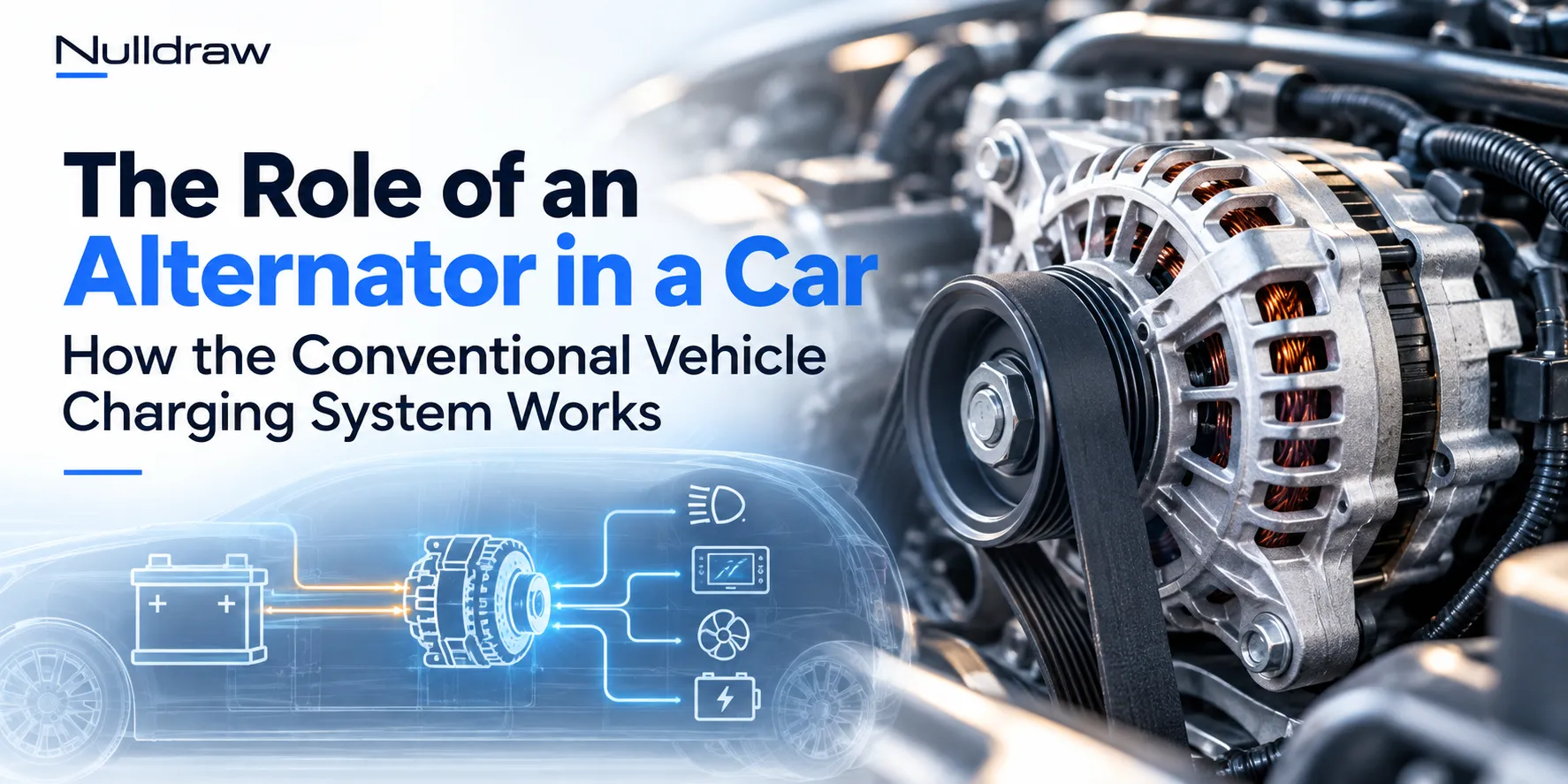
A conventional petrol or diesel vehicle depends on electrical power for far more than starting the engine. Lighting, engine control units, sensors, infotainment, climate-control components, safety systems, and numerous accessories all draw electrical energy while the vehicle is running. The role of an alternator in a car is to help supply that electrical demand while also replenishing energy used from the starter battery.
The alternator is therefore a central component of the vehicle charging system. It converts mechanical energy from the running engine into electrical energy, which is then regulated and distributed through the vehicle’s 12V electrical architecture. Understanding this process also helps explain why alternator load matters when considering alternative ways of supplying electrical power to conventional vehicles.
What Is the Role of an Alternator in a Car?
An alternator is an engine-driven electrical generator. Its primary job is to produce electricity for the vehicle’s electrical loads and maintain the starter battery’s state of charge after the engine has started.
When the engine is running, a belt typically transfers mechanical power from the engine’s crankshaft to the alternator. Inside the alternator, electromagnetic induction converts this mechanical input into electrical energy. The resulting output is rectified into direct current suitable for the vehicle’s electrical system.
In simple terms, the car alternator function can be divided into two main responsibilities:
-
Supplying electrical power to vehicle systems while the engine is running.
-
Recharging the starter battery after electrical energy has been consumed.
This makes the alternator a key part of the vehicle electrical system, rather than simply a device used to recharge the battery.
How Does an Automotive Alternator Work?
An automotive alternator contains several important components, including a rotor, stator, rectifier, voltage regulation system, bearings, and pulley assembly.
The engine rotates the alternator’s rotor. The rotating magnetic field interacts with windings in the stator and induces alternating electrical current. Because most vehicle electrical equipment requires direct current, a rectifier converts the generated AC into DC.
A voltage regulator helps control alternator output according to the vehicle’s electrical requirements and charging strategy. The exact control method varies between vehicle designs, but the basic principle remains the same: electrical generation must be coordinated with battery condition and current demand.
The alternator therefore does not simply produce a fixed amount of electricity continuously. Its operating load can change according to the vehicle’s electrical requirements.
Why Alternator Load Matters
Generating electrical power requires mechanical input from the engine. When electrical demand increases, the alternator can require more mechanical power to produce the additional electrical output.
Consider a conventional vehicle operating at night in cold weather. Headlamps, blower motors, heated systems, windscreen equipment, engine electronics, and other accessories can all contribute to the electrical load. The alternator must respond to this demand while the engine continues to provide propulsion.
This relationship between electrical demand and mechanical load is an important part of automotive energy management.
How Does the Vehicle Charging System Balance Electrical Demand?
The vehicle charging system consists primarily of the alternator, starter battery, electrical distribution system, wiring, and associated control electronics.
The starter battery provides electrical energy when the engine is off and supplies the high current required for engine cranking. Once the engine starts, the alternator becomes the primary electrical energy source under normal operating conditions.
The battery can still act as an electrical buffer. For example, when instantaneous electrical demand exceeds alternator output, the battery can help supply the difference. When generation exceeds immediate demand, available electrical energy can be used to replenish the battery.
This arrangement allows the vehicle’s electrical system to handle changing loads without requiring every electrical component to operate at exactly the same power level at all times.
For engineers assessing 12V electrical systems, this distinction between electrical demand, generation, storage, and mechanical input is particularly relevant.
Practical Considerations for Conventional Vehicles
Alternator operation is closely connected to how a vehicle is used. A passenger car that spends much of its time on longer journeys may have a different electrical operating profile from a vehicle that repeatedly starts, stops, idles, and operates accessories throughout the day.
The same principle becomes particularly relevant for commercial vehicles and urban delivery fleets. Vehicles can spend significant periods stationary with electrical systems still operating. Depending on the vehicle and its equipment, this can create a different relationship between electrical consumption, battery state, engine operation, and alternator activity.
Engineers and fleet operators therefore need to consider the complete vehicle energy architecture rather than looking at the alternator in isolation. Electrical loads, battery capacity, charging control, duty cycle, accessory use, and engine operation all interact.
Can Auxiliary Power Change How a Conventional Vehicle Uses Its Alternator?
One area of automotive engineering development involves separating some electrical energy requirements from the engine-driven generation system.
An auxiliary battery can provide stored electrical energy to selected vehicle loads under appropriate system conditions. If that energy is charged independently rather than generated by the engine, the vehicle’s electrical architecture can potentially be approached from a different energy-supply perspective.
Nulldraw is developing a concept based on a grid-charged auxiliary battery intended to supply a conventional petrol or diesel vehicle’s 12V electrical system so that the alternator can idle. The engine, alternator, and starter battery remain in place. The proposed system is currently a design in development, rather than a commercially available product.
This type of auxiliary power systems concept highlights an important engineering question: whether all electrical energy required during a vehicle’s operation necessarily needs to originate from engine-driven generation.
Future Considerations for Vehicle Energy Systems
As conventional vehicles continue to carry more electronic equipment, understanding electrical energy flows becomes increasingly important. The relevant engineering question is not simply how much electricity a vehicle consumes, but where that energy comes from, when it is required, how it is stored, and what mechanical systems are involved in generating it.
For automotive retrofit engineering, these considerations can be especially important because existing vehicles have established electrical architectures, charging controls, batteries, and safety requirements. Any proposed auxiliary power arrangement must therefore be considered as part of the complete vehicle system.
Nulldraw’s proposed approach remains in development and should be understood in that context. Its underlying concept focuses on supplying a conventional vehicle’s 12V electrical demand from an auxiliary battery charged from the grid, while leaving the conventional engine, alternator, and starter battery in place.
Conclusion
The role of an alternator in a car is fundamentally to convert engine-derived mechanical energy into electrical power for the vehicle’s electrical loads and to support charging of the starter battery. It is a central element of the conventional vehicle charging system, and its output is closely connected to the electrical demand placed on the vehicle.
Understanding this relationship is useful when examining automotive power management, fleet electrical loads, auxiliary batteries, and alternative vehicle energy architectures. The key principle is straightforward: electrical energy used by a conventional vehicle has an energy source, and when that source is an engine-driven alternator, electrical demand is connected to mechanical engine operation.
Emerging designs such as Nulldraw’s proposed auxiliary battery system explore different ways of supplying 12V electrical loads. As with any technology in development, its engineering concept should be evaluated within the complete vehicle electrical and energy system rather than viewed as a standalone component.
