
There is a quiet advantage to aluminum that rarely gets discussed in materials selection meetings. Steel comes in families, plastics come in formulations, and each tends to lock a manufacturer into a narrow lane of use. Aluminum is different. The same base metal, alloyed and heat treated appropriately, shows up in a municipal water pump, a defense transport housing, a wind turbine component, and a surgical robot, and nobody involved in those four projects would consider their material choices related.
That breadth matters more than it first appears. For equipment manufacturers, aluminum casting for pumps and valves is not a single-industry niche but a capability that transfers across markets, and the suppliers who master it tend to serve wildly different customers with the same core process. Understanding how one alloy family covers this much ground explains a lot about why aluminum castings keep appearing in places where engineers once assumed iron or steel was mandatory.
The Properties That Travel
Before looking at industries, it helps to see why aluminum adapts so readily. Four properties do most of the work.
Strength-to-weight. Through alloying and heat treatment, cast aluminum reaches strength levels that surprise engineers who last touched the material in a college lab. A heat treated casting in the 3xx series can carry operational stress, vibration, and shock loads at a third of the weight of an iron equivalent. That ratio is the reason the material shows up wherever things move, spin, or get carried.
Corrosion resistance. Aluminum forms a stable oxide layer that renews itself when damaged. No coating schedule, no repainting cycle, no galvanizing thickness to monitor. In wet service, outdoor exposure, or washdown environments, that self-protection changes the maintenance picture for decades.
Thermal conductivity. Aluminum moves heat roughly three to four times faster than cast iron. For housings that surround energized equipment, hot fluids, or friction-generating mechanisms, the enclosure itself becomes part of the cooling strategy rather than an insulating barrier.
Castability. Aluminum pours well, fills complex mold geometry, and holds detail. That lets designers consolidate assemblies: one casting replacing a bracket, a plate, and a fastened seam, with the fastened seam being the part that usually leaks first.
How the Same Alloy Serves Different Masters
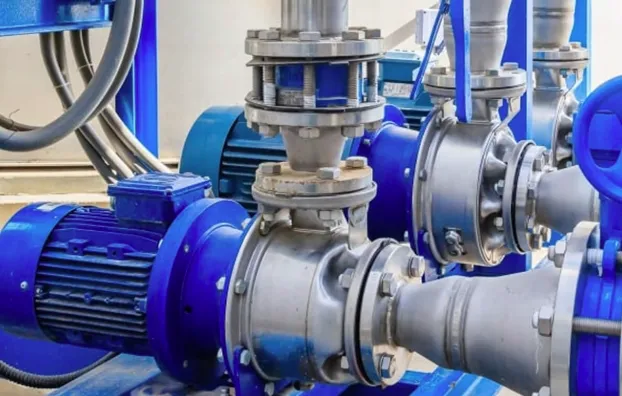
Pumps and fluid handling. The pump industry uses cast aluminum for housings, impellers, and components where weight and corrosion resistance pay off: portable and skid-mounted units, marine and washdown duty, and chemical-adjacent services where the fluid is compatible. The thermal conductivity helps dissipate friction heat from seals and bearings, and the casting process allows internal passages to be formed integrally rather than drilled and plugged.
Valves and actuators. The valve side of fluid control leans on aluminum for actuator housings and covers, the enclosures that protect the gearing and drive components doing the actual work of opening and closing flow. These parts live in unglamorous conditions: bolted to pipeline hardware, exposed to weather, absorbing torque reactions and vibration for years. The corrosion resistance handles the weather, the strength-to-weight handles the torque loads, and the weight reduction matters on actuators mounted high on large assemblies where a service technician has to reach them.
Transportation. Rail, marine, and electric vehicle applications adopt aluminum for the same reasons the pump world does, but with the volume turned up. Weight directly drives energy consumption in anything that moves, and cast components that shave pounds from repeated parts multiply savings across a fleet. Vibration resistance matters here too, since transport equipment rarely sits still long enough for corrosion to be the primary enemy.
Defense. Military equipment demands the harshest combination: shock loads, rough handling, extreme environments, and strict documentation. Cast aluminum serves in transport components and equipment housings partly for the weight advantage, which affects deployment logistics, and partly because the casting process can produce the rugged, consolidated geometries that survive field abuse. Defense work also drags its suppliers into rigorous inspection regimes, and those quality habits transfer back to commercial customers.
Power generation and grid equipment. Transformer housings, cooling fins, inverter enclosures, and substation hardware all use cast aluminum, and the reasons overlap heavily with the pump world: thermal management, outdoor corrosion resistance, and weight on structures. A foundry serving both markets is essentially selling the same physics to two different audiences.
Medical and robotics. Surgical robots and diagnostic imaging equipment use aluminum castings for housings and structural components where weight affects precision and where EMI shielding and thermal management matter. The tolerances are tighter and the volumes lower, but the material logic is identical.
Why Cross-Industry Experience Matters to Buyers
Here is the practical point for anyone sourcing cast components. A supplier that serves only one industry learns only that industry’s habits. A foundry casting pump housings in the morning and defense components in the afternoon absorbs lessons from both: the volume discipline of high-production molding work, the documentation rigor of military specifications, the inspection standards of pressure-containing parts.
That cross-pollination shows up in places buyers might not expect. The digital radiography used to verify a defense casting becomes the same technique that catches porosity in a pump housing before it becomes a warranty claim. The pattern-making skill developed for a low-volume medical part becomes the tooling flexibility that saves a pump OEM’s legacy product line when the original drawings no longer match anything in a catalog. The automatic molding equipment that keeps high-volume housing production consistent also demonstrates a process control discipline that carries into custom work.
There is a supply reliability angle as well. Manufacturers learned between 2020 and 2023 what single-market dependence costs. A casting supplier with customers across transportation, energy, defense, and fluid control has revenue resilience that single-industry suppliers lack, which means the pump OEM’s critical parts supplier is less likely to disappear when one market dips. Boring consideration, real consequence.
The Common Thread in Quality
Across all these industries, the quality expectations converge on the same short list, which is telling. Buyers want internal soundness, verified through radiographic inspection where the part warrants it. They want surface integrity, checked through penetrant testing on critical components. They want dimensional accuracy on machined surfaces, because castings are only the starting point for finished parts. And they want alloy consistency, documented, heat after heat.
The industries differ in degree, not kind. Defense documentation runs thicker than agricultural equipment documentation, and medical tolerances run tighter than municipal pump tolerances, but the underlying questions are identical: is the casting sound inside, will it hold its dimensions, and can you prove it. Suppliers who answer those questions well for one market tend to answer them well for all of them, which is exactly why the cross-industry pattern exists in the first place.
The Bottom Line
Aluminum’s range across pumps, valves, actuators, and beyond is not an accident of marketing. It is the direct consequence of a property set, light, corrosion-resistant, thermally conductive, and castable into complex shapes, that solves recurring engineering problems in industry after industry. For manufacturers, the takeaway is twofold. When evaluating a material for a new housing or enclosure, the aluminum question deserves asking even if your industry’s tradition says iron. And when evaluating a casting supplier, ask what other industries they serve, because the answer tells you what habits they bring to your parts. The alloy is one. The duties are many. The suppliers who understand both are the ones worth quoting.
